
In brief
- For food-contact plastics, migration limits, good manufacturing practice and the chain of declarations of compliance are set by legislation.
- Acetaldehyde (AA) is a volatile compound formed during melt processing of PET; even at low levels it can affect the taste of water.
- Raw material selection, drying, melt temperature and residence time determine the AA level; measurement is carried out by gas chromatography.
PET is a polymer suitable for food contact and widely used in water, beverage and food packaging. However, the safety of packaging does not depend on its raw material alone. How the raw material is dried, at what temperature it is processed and how production is controlled also determine the quality of the end product. In this article we look at the basic regulatory framework for food-contact PET and at acetaldehyde control, one of the most closely monitored parameters in preform production.
Regulatory framework
In the European Union, plastic materials intended to come into contact with food are regulated by Regulation (EU) No 10/2011. The Regulation defines the list of substances that may be used, the overall migration limit (10 mg/dm²) for the total amount of substances that may migrate from the packaging into the food, and specific migration limits for certain substances. Regulation (EC) No 2023/2006 governs good manufacturing practice (GMP) in the production of food-contact materials. In Türkiye, the same field is regulated by the legislation on plastic materials and articles intended to come into contact with food under the Turkish Food Codex.
An important part of this system is the declaration of compliance. Every link in the chain, from the raw material producer to the packaging manufacturer and from there to the filler, must document regulatory compliance at its own stage.
PET and BPA
Bisphenol A (BPA) is a substance used in the production of polycarbonate and some epoxy coatings. BPA is not used in the production of PET. None of Teknopet’s PET, HDPE and PP products contain BPA.
What is acetaldehyde and why does it matter?
Acetaldehyde (AA) is a volatile compound formed by the thermal degradation of polymer chains during the injection stage, in which PET is melt-processed. This compound, which also occurs naturally in some fruits, imparts a slightly fruity taste and odour. AA can migrate from the packaging into the product inside. Particularly in waters with a neutral taste, even very low concentrations can cause a taste deviation that consumers may notice. For this reason, the AA level is closely monitored in preforms produced for water bottles.
Factors determining the AA level
- Raw material: PET grades developed for water applications and produced to generate low AA are preferred.
- Drying: PET absorbs moisture. Insufficiently dried raw material undergoes hydrolysis in the melt; the I.V. drops and process stability is impaired. Moisture measurement and the correct drying temperature are therefore the first checkpoint of production.
- Melt temperature: An unnecessarily high melt temperature increases thermal degradation and AA formation.
- Residence time: The longer the melt remains at high temperature in the screw and hot runner system, the more AA increases.
- Shear: Parameters such as screw speed and injection speed can cause local heating in the melt.
How is AA measured?
The common method for measuring AA is gas chromatography. A sample taken from the preform is ground and heated in a sealed vial; the AA released from the sample is measured by headspace gas chromatography. The result is usually expressed in ppm relative to the preform weight. The measurement frequency and acceptance limits are determined according to the product’s field of use and the customer specification.
In the Teknopet quality laboratory, the AA content of preforms is measured by gas chromatography. The moisture content of the raw material is checked before production; intrinsic viscosity (I.V.) is measured with an Ubbelohde tube.
Other quality parameters
- I.V.: An indicator of polymer chain length; a low I.V. adversely affects mechanical strength and blow moulding behaviour.
- Colour: The colour tone and yellowing tendency of the preform are monitored with a colour measuring instrument.
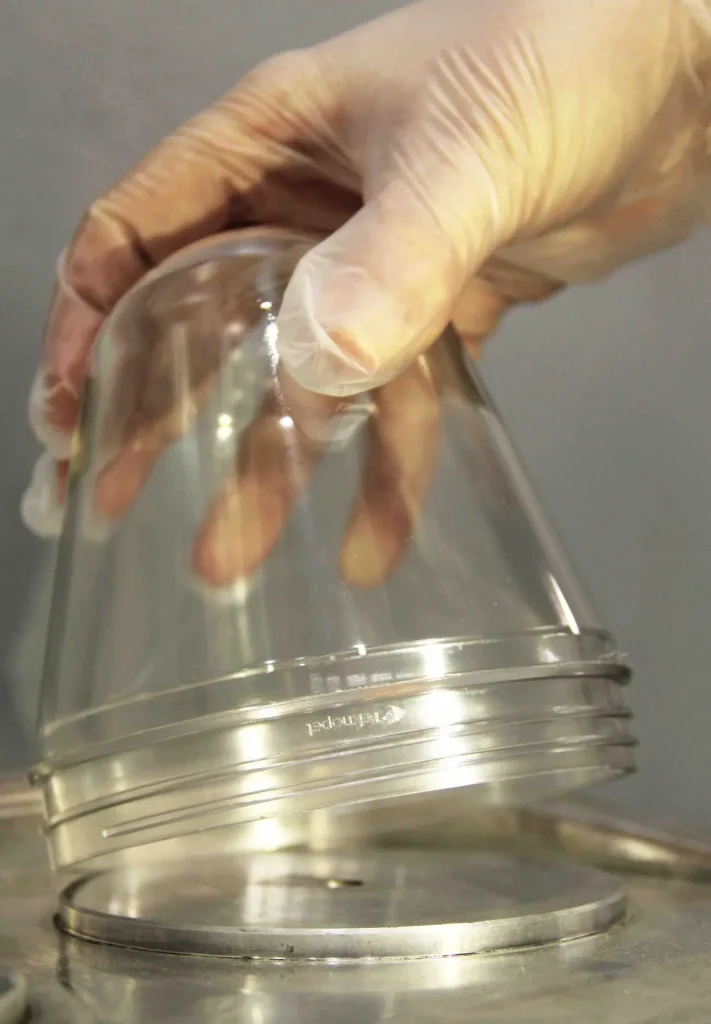
- Visual defects: Bubbles, whitening (undesired crystallisation), short shots and silver streaks are looked for during sample inspection.
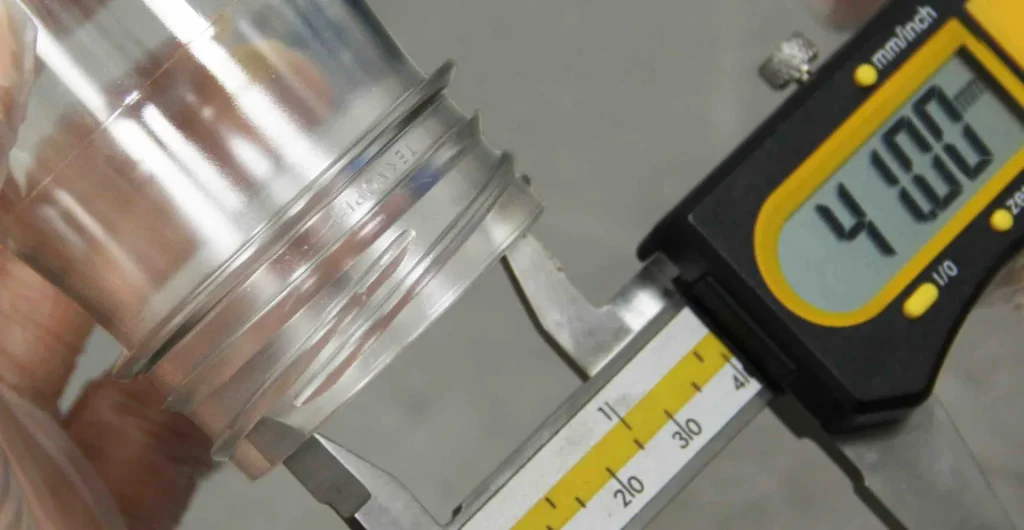
- Weight and dimensions: Preform weight and neck dimensions are checked with precision balances and measuring instruments.
Records and traceability
Recording measurement results is as important as their reliability. In the Teknopet laboratory, measurements are transferred electronically at the moment of measurement, in accordance with Good Laboratory Practice (GLP) principles. The measurement history of every production batch can thus be traced back.
Related special product: Triple A™ Acetaldehyde Reducer Preforms, in which the AA level is reduced with additive technology.
Our laboratory and quality process
See our moisture, I.V., acetaldehyde, colour and leak-tightness tests on our quality page.
Legislation and sources
- Regulation (EU) No 10/2011 – plastic materials and articles intended to come into contact with food
- Regulation (EC) No 2023/2006 – good manufacturing practice for materials intended to come into contact with food
- Turkish Food Codex – legislation on plastic materials and articles intended to come into contact with food